

At The Platinum Group, we are a People-Powered, Client-Focused, and Results-Driven organization. We provide Financial Services for Small to Mid-Size Businesses through an integration of Insurance and Risk Management services. Our team is dedicated to guiding you through the process, offering personalized solutions that cater to your business’s unique needs. Over the past decade, the commercial property insurance market has faced ongoing challenges. Limited underwriting profitability—driven by a sharp increase in catastrophe (CAT) losses, inflation, and issues with property valuation—has contributed to a hardened market. As a result, policyholders have seen rising premiums and tighter coverage terms become the norm.
Contact The Platinum Group today at 909.466.7876 for personalized insurance insights and risk management solutions tailored to your business. Also, don’t forget to check out the Commercial Auto Insurance 2025 Midyear Market Outlook on our blogs/resources page.
Market Overview for Commercial Property Insurance

In early 2023, average rate increases peaked at around 20%. However, pricing began to ease in 2024, with rate hikes falling to 6% by the fourth quarter. Now, midway through 2025, the trend of stabilization continues. Average rate increases are currently just below 3%, thanks to improved underwriting results, stronger reinsurance capacity, a reduction in inflation-related pressures, and increased competition among insurers for high-quality accounts.
That said, premiums and coverage options still vary greatly depending on factors like property use and the level of exposure to natural disasters.
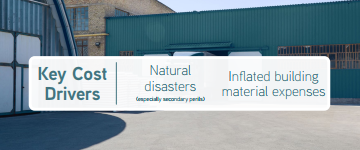
Catastrophe Risk Remains a Key Driver
Despite signs of market improvement, the frequency and severity of natural disasters continue to place pressure on the sector. So far in 2025, wildfires and convective storms have been particularly destructive. For example:
- The Eaton Fire and Palisades Fire devastated Southern California throughout January, destroying over 15,000 structures.
- In May, a wave of tornadoes and hailstorms damaged roughly 63,000 properties across the Ohio River Valley and the Midwest.
In total, insured losses from these events are expected to exceed $50 billion. Even more concerning, the National Oceanic and Atmospheric Administration (NOAA) has forecast an above-average Atlantic hurricane season, with up to 19 named storms and five major hurricanes. By year-end, insured losses from natural disasters could reach a staggering $145 billion worldwide.
Given this outlook, policyholders—especially those in high-risk regions—should expect continued scrutiny from insurers regarding disaster preparedness measures.
Contact The Platinum Group today at 909.466.7876 for personalized insurance insights and risk management solutions tailored to your business. Also, don’t forget to check out the Commercial Auto Insurance 2025 Midyear Market Outlook on our blogs/resources page.
The Role of Insurance-to-Value (ITV)
Another persistent challenge in the commercial property insurance space is the issue of inaccurate insurance-to-value (ITV) calculations. These figures are meant to ensure policyholders carry enough coverage to match the value of their properties, factoring in actual, market, and replacement values.
Unfortunately, rising material costs and recent supply chain disruptions have made accurate calculations more difficult. While inflation has eased slightly in 2025, new U.S. tariffs on steel, aluminum, and lumber may push prices higher again. As a result, insurers are increasing oversight and, in some cases, issuing penalties for underreported property values.
Alternative Risk Financing on the Rise
In response to these challenges, more policyholders are exploring alternative risk financing options, such as:
- Captives – Insurance companies created by a parent company to insure their risks.
- Parametric coverage – Policies that pay based on the severity of an event (e.g., wind speed), not the actual damage cost.
- Structured fronting – Policies issued by licensed insurers but backed primarily by third-party reinsurers or captives.
These options allow businesses to customize their coverage and may offer cost efficiencies, particularly for companies with unique risk profiles.
Looking Ahead
The remainder of 2025 is expected to bring continued moderation in the commercial property insurance market. Policyholders with low CAT exposure and favorable loss histories may benefit from:
- Stable or slightly reduced premiums
- Better access to coverage
- Greater insurer flexibility, especially in shared or layered program structures
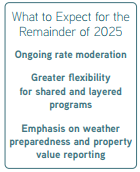
However, high-risk properties and accounts with significant prior losses will still face tough underwriting standards. Moreover, the market remains sensitive to natural disasters—one major event could cause rates and availability to shift overnight.
Final Thoughts on Commercial Property Insurance for 2025
In a landscape defined by volatility, staying proactive is key. By keeping up with market trends, refining risk strategies, and considering alternative coverage options, businesses can position themselves for stability and resilience.
